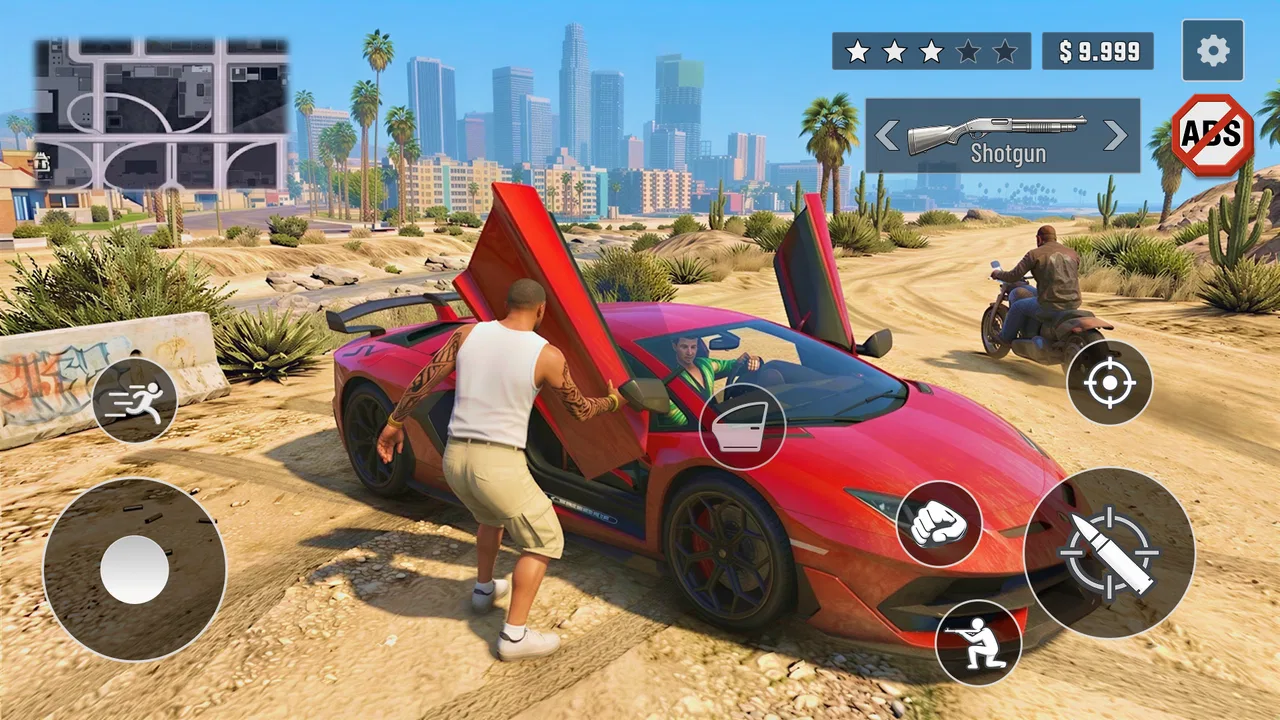
Mafia City RP:Grand Open World
- 4.5
- Rating
- 1.00M
- Installs
- Free
- Price

 Analysis by App-foxy
I approached Mafia City RP:Grand Open World expecting a simulation game built around the fantasy of making a name for myself in a criminal city. What stood out first was not a single gimmick, but the promise of an open setting where my choices are supposed to shape the way I play. That makes it more interesting than a simple action game, although it also means the experience depends heavily on how much freedom and patience I am willing to bring to it.
This is a free simulation game from Universe Game Labs, rated for Everyone. It has already passed one million installs and holds a 4.5 average from around 3.7 thousand ratings, which suggests that the central idea has found an audience. The game is currently at version 0.1.3, so I see it as an early-stage experience rather than a finished, definitive city simulator. That distinction matters: I enjoyed the concept, but I also judged it by whether its systems feel ready for long-term play.
Choosing what kind of city life you want
The strongest part of the game is its decision space. A title built around mafia roleplay can easily become a sequence of missions with a criminal theme placed on top. Here, the more appealing way to play is to think about the kind of character I want to be before rushing from one activity to the next. Do I want to behave like an ambitious operator, a cautious survivor, or someone who enjoys the social side of roleplay more than constant confrontation?
You May Also Like

 Blood Strike: 2.5 Anniversary
Blood Strike’s Loadouts Turn Every Drop Into a Tactical Gamble
A close look at Blood Strike’s custom loadouts: how fast access to signature weapons reshapes its battle royale rhythm, rewards preparation, and narrows the gap between fights.

 Pandora - Music & Podcasts
Pandora’s Music Is Easy to Start, but Harder to Recover
Pandora’s strength is its low-effort path from a seed to a station. Its weak spot is how much confidence it asks you to place in connection, setup, and quiet recovery.

 8 Ball Pool
 Is Built on Rivalries, Rematches, and Routine
A close look at the rivalries, rematches, shared routines, and unanswered safety questions that turn a quick pool match into a persistent mobile community.

 Samsung Music
’s Quiet Strength Is Playing What You Already Own
Its reach comes less from spectacle than from dependable access to a personal library. That simplicity is both the app’s strongest retention engine and its ceiling.

 AccuWeather: Weather Radar
AccuWeather Review: A Quick, Clear Forecast for Everyday Decisions
For everyday plans, the best forecast is the one you can understand quickly. AccuWeather makes rain timing, radar, and local conditions easy to act on, with a few trade-offs.

 Hill Climb Racing
Why Hill Climb Racing Still Turns Crashes Into One More Run
A tiny car, a bumpy hill and one more upgrade: Hill Climb Racing keeps resurfacing because its simple chaos makes every near-miss feel personal.
More From Our News Desk
View All News


That question changes how I approach the city. I found myself paying attention to timing, positioning, and the consequences of acting too quickly. Even when the game does not force a complicated plan, making one improves the experience. I prefer to decide what I am trying to achieve, identify the safest route toward it, and only then commit. That habit makes the open-world setting feel more purposeful than simply wandering until something happens.
For a new player, my advice is to resist the urge to treat every encounter as an invitation to create chaos. A roleplay game becomes more enjoyable when I give my actions a little context. If I am building a reputation, I should behave consistently. If I am trying to avoid trouble, I should not create unnecessary attention. This may sound obvious, but it is the difference between using the city as a playground and using it as a setting for a personal story.
The game is also easy to understand at a basic level because its premise is familiar. I do not need to learn a dense strategy interface before I can begin. That accessibility suits casual sessions, especially when I only want to explore the setting or experiment with a different approach. At the same time, players who expect a detailed management simulator may find the roleplay framing more important than precise economic planning.
One useful way to play is to set a small objective for each session. Instead of trying to become powerful immediately, I might focus on learning the city, testing how much freedom I have, or seeing how a cautious approach compares with a bold one. This creates a natural learning loop. I am not just collecting progress; I am discovering which decisions produce the kind of experience I actually want.
Why planning matters more than rushing
My favorite moments came from treating actions as commitments rather than disposable button presses. Before taking a risk, I consider what I gain, what I might lose, and whether the reward is worth changing the direction of my session. That approach gives the game a more thoughtful rhythm and prevents the open world from becoming a blur of unrelated events.
There is also a practical benefit to planning. When I make a mistake, I can usually identify whether the problem was poor timing, overconfidence, or a failure to understand the situation. That makes experimentation useful. I am not simply restarting because the game surprised me; I am adjusting my behavior for the next attempt.
I would recommend this mindset especially to players coming from fast action games. If you expect immediate rewards and constant spectacle, the slower decision-making may feel less exciting. If you enjoy shaping a character through choices, the same pace becomes one of the game’s better qualities.
Risk, reward, and the cost of attention
The mafia setting naturally creates a risk-and-reward structure, even when I am playing informally. A safer choice may produce slower progress, while a more aggressive choice can create a memorable advantage or a difficult problem. I like that tension because it gives ordinary movement through the city a strategic purpose. I am always asking whether I am acting because it is smart or simply because it is available.
One of the most useful habits I developed was separating short-term success from long-term benefit. A decision that feels rewarding immediately may leave me with fewer options later. Conversely, a cautious move can seem uneventful but preserve my ability to respond when the situation changes. This is where the simulation label makes sense to me: the game is most engaging when I think about consequences rather than isolated wins.
That does not mean every action needs to become a serious calculation. I still enjoy playing spontaneously, and sometimes the fun comes from accepting an uncertain outcome. The important point is that the game gives me room to choose my level of commitment. I can play casually for a few minutes, or I can turn a session into a small experiment about how far a particular strategy can go.
A realistic everyday scenario is a short evening session after work or school. I might have only enough time to enter the city, pursue one objective, and leave. In that situation, I would avoid starting a chain of risky decisions that needs a long uninterrupted session. I would choose a clear target, keep my route simple, and use the session to learn something specific. That makes the game fit better into real life than trying to force a dramatic story every time I open it.
The main friction is that an open-world roleplay game can feel less rewarding when I want a clearly directed experience. Players who prefer a succession of polished levels, obvious objectives, and dependable pacing may find the freedom less satisfying. The game asks me to create some of the structure myself, and not everyone wants that responsibility from a mobile game.
I also think the early version affects how confidently I can recommend it for long sessions. Version 0.1.3 communicates that the project is still developing. I can enjoy the foundation, but I would not approach it expecting the breadth or refinement of a long-established simulation series. For me, the right expectation is to explore what is already there and judge whether the core loop is enjoyable enough to revisit.
Using failure as information
When a decision goes badly, I try not to repeat it immediately without changing anything. I look at the sequence that led there: Did I move too quickly? Did I take a reward without considering the next step? Did I choose a route that left me with no alternatives? This kind of review is one of the game’s less obvious strengths because it turns mistakes into practical knowledge.
My best tip is to change only one variable at a time. If I alter my route, timing, and attitude all at once, I cannot tell what helped. If I keep most of my approach the same and adjust one decision, the result becomes easier to understand. That is a simple method, but it makes the game feel more strategic and gives repeated attempts a real purpose.
Another useful trade-off is deciding when to stop. If a session has already produced a good result, continuing to chase a larger reward can turn a successful run into a frustrating one. I prefer to end on a clear objective when possible. That keeps the next session inviting instead of making the game feel like a punishment for being ambitious.
Adapting when the first plan fails
A city roleplay game needs flexibility because no single approach should feel correct all the time. In my experience, the most satisfying adaptation is not a complete personality change, but a small adjustment to how I handle pressure. I might become more patient, choose a less exposed route, or postpone an attractive opportunity until I understand the situation better.
This is where the game can appeal to different kinds of players. Someone who enjoys improvisation can treat unexpected problems as part of the story. Someone more methodical can build a repeatable routine and refine it. I prefer moving between both styles: I begin with a plan, then allow the city to challenge it rather than becoming annoyed when the original idea stops working.
Players should also decide whether they want to roleplay seriously or simply enjoy the setting. Both approaches are valid, but they produce different expectations. Serious roleplay requires consistency and imagination from the player. Casual play is more forgiving and makes it easier to experiment. I would not recommend forcing a strict roleplay style if the game’s freedom is not giving you enjoyment; the point is to find a way of playing that keeps the decisions meaningful.
Compared with more conventional mobile action games, this title gives me more responsibility for creating context. A typical action game may tell me exactly where to go and what success looks like. Here, the appeal is closer to building a personal narrative inside an open setting. That makes it less immediately directed, but potentially more replayable for someone who enjoys inventing goals.
Compared with management-heavy simulation games, however, I would choose a different option if my main interest were detailed finances, production chains, or precise resource optimization. The mafia fantasy is the focus here, not a spreadsheet-like business simulator. I would also look elsewhere if I wanted a tightly authored story with carefully timed scenes. This game is better suited to players who want room to make their own decisions.
One practical question is whether the game is suitable for a younger audience. Its content rating is Everyone, which makes it broadly accessible from a rating perspective. Even so, I would still consider whether the crime-themed setting matches the player’s personal preferences. A general age rating does not mean every player will enjoy the subject matter or the kind of roleplay it encourages.
Small experiments that improve the experience
I found three experiments especially useful. First, I played one session with a conservative goal and another with a more ambitious goal, then compared which one felt more satisfying rather than merely more successful. Second, I deliberately paused before committing to a tempting opportunity, which helped me see whether anticipation improved the outcome. Third, I treated the city as a place to observe rather than conquer, looking for patterns in how I naturally moved and what kinds of situations made me uncomfortable.
These experiments do not require hidden knowledge or complicated preparation. They simply make the player more aware of the choices the game is offering. The benefit is that progress becomes personal. I learn whether I enjoy risk, planning, social roleplay, or exploration instead of assuming the game must be played in one prescribed way.
I would also suggest keeping expectations realistic about mobile play. Touch controls and shorter sessions encourage direct interaction, but they do not automatically create the depth of a large console or computer open world. The game works best when I value the freedom to make decisions within its setting, not when I compare every detail with much larger productions.
What remains interesting over time
Long-term depth depends on whether the player can keep finding new reasons to enter the city. For me, that comes less from repeating the same objective and more from changing the rules I set for myself. I can pursue a different character concept, choose a new risk tolerance, or focus on observing how my decisions affect the shape of a session.
That kind of depth is real, but it is also demanding. A game cannot supply all of the imagination on the player’s behalf. If I need constant new missions or a steady stream of explicit rewards, the experience may lose its appeal sooner. If I enjoy self-directed play, the same structure can remain interesting because every session becomes a small test of judgment.
The developer, Universe Game Labs, has positioned the game around a broad open-world mafia fantasy, and the current version feels like a foundation for that idea. I appreciate the ambition, but I would be careful about recommending it as a complete replacement for every other simulation game. Its strongest quality is the freedom to decide how I want to approach the setting, while its weaker side is the uncertainty that comes with an early project and a less tightly guided format.
Another question many players will have is whether the game costs anything to try. It is free, so the barrier to entry is low. That makes experimentation easier: I can install it, test the roleplay loop, and decide whether the open-world structure suits me without committing to a purchase. The more important cost is time and attention. If I do not enjoy creating my own goals, free access will not solve the underlying mismatch.
Device compatibility is also straightforward for many older phones and tablets because the minimum operating system is Android 7.1. That widens the range of devices that can attempt the game. Still, compatibility is not the same as identical performance, so I would keep my expectations sensible on older hardware and judge the experience by how comfortably it runs on the device I actually use.
The game’s audience size is encouraging, with over one million installs, but popularity alone does not determine whether it is right for me. I pay more attention to the kind of engagement it creates. If I finish a session thinking about a decision I could have handled differently, that is a better sign than simply seeing a large install figure. The positive average rating supports the idea that the core concept works for many players, while my own enjoyment still depends on tolerance for open-ended play.
Who should play and who should skip it
I would recommend Mafia City RP:Grand Open World to players who enjoy simulation games with a criminal-city theme, self-directed objectives, and room to roleplay. It is a good fit for someone who likes asking, “What would my character do next?” rather than waiting for the game to provide a perfectly marked path. It also suits players who enjoy learning from failed decisions and gradually developing a preferred style.
I would skip it if I wanted a polished, tightly scripted crime story, a fully detailed management system, or nonstop action with minimal planning. I would also be cautious if I dislike early-stage games and expect every part of an open world to feel equally deep. The current version is more appealing as an evolving experience than as a final, all-purpose simulation.
For a friend deciding whether to try it, I would say this: give it a focused first session instead of judging it after a few random minutes. Choose one roleplay idea, make a modest plan, and see whether the freedom feels exciting or empty. That test reveals more than simply moving around the city without a goal.
My strategy verdict
Mafia City RP:Grand Open World works best when I treat it as a decision-making sandbox rather than a conventional mission-driven action game. Its appeal comes from choosing how much risk to accept, how seriously to roleplay, and how patiently to build a personal path through the setting. The free price and Everyone rating make it easy to sample, while the strong average rating and large install base show that the concept has connected with a substantial audience.
My honest verdict is positive but measured. I like the freedom, the room for experimentation, and the way a simple plan can make a session feel more meaningful. I also recognize the trade-off: the game asks me to supply motivation, and its early version means I should not expect the completeness of a mature open-world simulator. That is not a reason to dismiss it; it is a reason to approach it with the right expectations.
If you want to build your own mafia-themed story, test different levels of caution, and make the city feel personal through your choices, I think it is worth trying. If you need a fixed narrative, deep business management, or immediate action every time, another game will probably serve you better. For me, the strongest reason to return is not the promise of becoming powerful quickly, but the chance to see whether a smarter decision can change the next session.
FAQs for Mafia City RP:Grand Open World
01What is Mafia City RP: Grand Open World about?
Mafia City RP: Grand Open World is an open-world role-playing game focused on crime, exploration, and social interaction. After entering the city, you can create a character, move around freely, take part in missions, earn money, acquire vehicles, and interact with other players. The experience combines driving, progression, customization, and role-play elements rather than following only a linear story.
02Can I play Mafia City RP: Grand Open World offline?
The game is primarily designed as an online experience, so an internet connection is generally required for accessing its main features, multiplayer activities, city interactions, and account progression. Playing with a stable connection is recommended because weak or interrupted service may cause loading problems, disconnections, or delayed actions. Before downloading, check the current store listing for the latest network and device requirements.
03Is Mafia City RP: Grand Open World free to download?
Mafia City RP: Grand Open World can generally be downloaded without an upfront purchase, but free access does not necessarily mean that every feature is completely free. Games in this category may include optional in-app purchases for currency, cosmetic items, vehicles, upgrades, or other conveniences. Review the store page and your device’s purchase settings before playing, especially if children use the device.
04What devices are compatible with Mafia City RP: Grand Open World?
Compatibility depends on the operating system version, available storage, memory, and the specific version published for Android or iOS. Because open-world games can be demanding, older phones may experience longer loading times, reduced graphics quality, overheating, or performance drops. Make sure your device has enough free space and install the latest system updates before downloading the game.
05Does the game include multiplayer or role-playing interactions?
Yes, the game’s concept is built around an interactive city where players can participate in role-playing activities and engage with other users. Depending on the available servers and updates, this may include jobs, missions, driving, character customization, social encounters, and competition. Online interaction can also expose players to chat or user-generated behavior, so parental supervision and privacy awareness are advisable.
Pros
- Large open-world map offers plenty of places to explore.
- Roleplay activities provide variety beyond standard combat missions.
- Vehicle selection makes traveling and escaping more engaging.
- Character customization helps create a personal criminal identity.
- Frequent encounters with other players keep the city feeling active.
Cons
- Progress can feel slow without spending money on upgrades.
- Online interactions may include disruptive or uncooperative players.
- The open world can become repetitive after extended play sessions.
- Older or budget devices may experience lag in busy areas.
- Some missions provide limited guidance for new players.

Mafia City RP:Grand Open World
Gallery